A significant scientific breakthrough has occurred in one of the most isolated regions on Earth. An international team of researchers has successfully drilled deep into West Antarctica, obtaining a 228-meter-long core of rock and sediment—making it the deepest sample ever extracted from beneath the Antarctic ice. This achievement is part of the SWAIS2C project, led by Earth Sciences New Zealand, Te Herenga Waka Victoria University of Wellington, and Antarctica New Zealand. While it may appear as just a long tube of mud and rock, this core holds valuable clues about Earth’s past climate—and potentially its future, especially regarding rising sea levels.
Where and How the Core Was Extracted
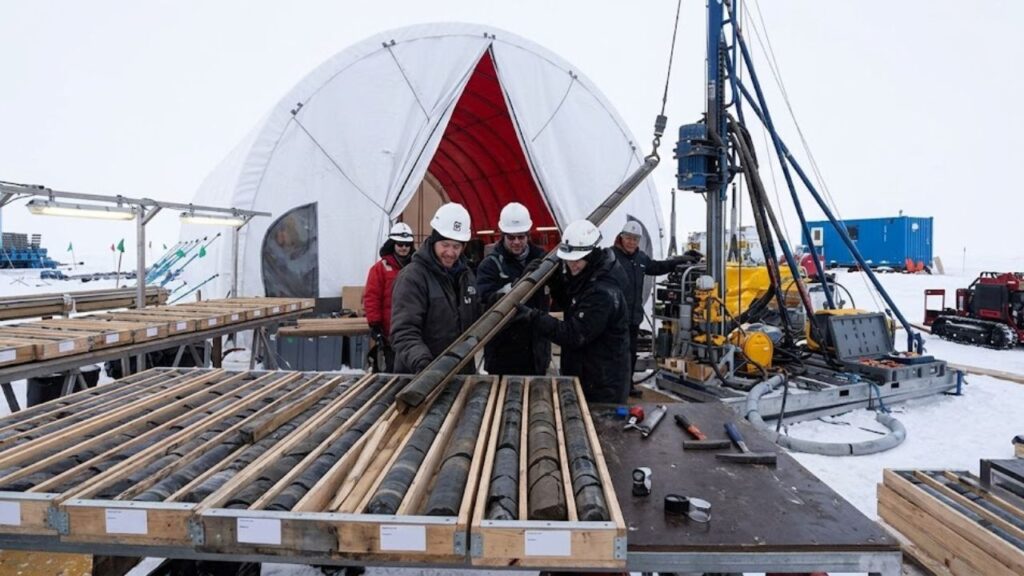
The drilling took place at Crary Ice Rise, buried beneath 523 meters of thick ice, located more than 700 kilometres from Scott Base. Reaching the sediment under such extreme conditions required advanced technology and careful planning. Scientists used a hot water drill to melt a vertical shaft through the ice. Once they reached the base, a specialized drilling system was used to extract sections of sediment, each up to 3 meters long. These segments were then brought to the surface and assembled into a continuous 228-meter core.
Why This Discovery Matters
Sediment cores are often referred to as “timelines of the Earth.” Each layer represents a different historical period, with newer materials on top and older ones below. By studying these layers, scientists can reconstruct past climates, ocean conditions, and ice sheet behaviour. This particular core is significant because it comes from beneath the West Antarctic Ice Sheet, which plays a crucial role in global sea levels. If this ice sheet melts completely, it could cause a rise in global sea levels by around 4 to 5 meters (13 to 16 feet).

Evidence of a Warmer Antarctica
One of the most surprising findings from the core is the evidence that parts of West Antarctica were once not covered by thick ice. Instead, they were exposed to open ocean during warmer periods in Earth’s history. The sediment layers tell this story clearly. Coarse gravel and large rock fragments indicate times when glaciers covered the area, while fine mud with shell fragments and microscopic marine organisms suggest periods of open water. Some of these marine organisms require sunlight, implying that the region must have been ice-free at certain times. This challenges the long-held assumption that Antarctica has always been permanently frozen.
What Scientists Are Hoping to Learn
The main goal of analysing this core is to understand how the Antarctic ice sheet responds to climate change. Satellites have shown that the ice sheet is losing mass, but there is still uncertainty about how quickly it could retreat with continued warming. By studying past warmer periods, scientists can identify patterns and tipping points. These insights will help improve climate models and make predictions about future sea level rise more accurate. Huw Horgan, one of the researchers involved, emphasized that the core could provide “critical insights” into Antarctica’s behaviour in a warmer world.
Why This Matters for the World
Although this discovery took place in a remote part of Antarctica, its implications are global. Rising sea levels affect millions of people, particularly those in coastal cities and low-lying areas. Better predictions of sea level rise will help governments and communities plan infrastructure, flood defences, and protect coastal ecosystems. This core could play a pivotal role in helping the world adapt to climate change and prepare for future risks.

Filling a Critical Scientific Gap
For years, scientists have emphasized the need for direct evidence from beneath the West Antarctic Ice Sheet. Most previous data came from coastal or offshore areas, which only provided a partial picture. This new core helps fill that gap, offering a more comprehensive view of how the ice sheet has changed over millions of years. A 2022 study highlighted the importance of obtaining deeper inland records to fully understand the region’s history.
The Work Is Just Beginning
While extracting the core was a major achievement, the real work is just beginning. Scientists from 10 different countries are now analysing the sample in detail. They will determine the exact age of each layer, study chemical and biological markers, and reconstruct past temperature and ocean conditions. This process will take years, but the results could revolutionize our understanding of Earth’s climate system.
Conclusion
The extraction of a 228-meter sediment core from beneath West Antarctica is a landmark achievement in climate science. It offers a rare glimpse into the planet’s past, revealing that even the coldest regions of Earth have experienced dramatic changes. More importantly, it provides critical insights into the future. As global temperatures continue to rise, understanding how ice sheets responded in the past can help predict what lies ahead. What may seem like a simple tube of mud and rock is, in reality, a powerful record of Earth’s history—and a warning about its future.